• Skip to primary navigation
  • Skip to main content
  • Skip to primary sidebar
  • Skip to footer

Petsium - Veštačka Inteligencija | AI

Vestacka Inteligencija Aplikacija i Chat

  • Vestacka Inteligencija
  • Kontakt
  • Uslovi Koriscenja

liv parmel

How to Stop Dog Growling

новембар 17, 2020 By liv parmel

Before we address the issue of how to stop dog growling, it is important for you to understand why does a dog growl? It is in the roots of your dog. Your pet dog is descendants from wild wolves. Yes, even your little sweet chihuahua has a wolf inside of her. Through time and evolution, wolves have adapted to live along side man.

DOG GROWLING

Why Is My Dog Growling?

Wolves were the first animals to be domesticated by humans. Your pet pooch has the natural instincts of her great ancestors inside of her. There will be times when your dog will want to naturally test her boundaries, it’s the wolf inside of her.

Also keep in mind that dogs growl when they feel threatened. They growl for a number of reasons. In order to stop dog growling, know it’s normal for dogs to growl, know when it becomes a problem. A growling dog may or may not be a cause for concern.

But when your dog growls at you, other people, other animals, you need to take action to prevent this kind of behavior from worsening. What I mean from worsening is a growling dog can easily turn into a biting, snarling, snapping dog-causing reasons to be alarmed. Don’t forget, a puppy growling is one thing, a grown dog growling with aggression is another.

Here are some things you can do to prevent and stop dog growling.

How To Stop A Dog From Growling?

Ask Yourself This, „Is Your Dog the Alpha“?

Dogs are pack animals. Wolves live together in a pack, and in this pack they have one leader, the Alpha dog. It is crucial for your dog to learn that YOU are the alpha leader in his pack (family).

Wolves were the first to eat in the pack, made all the decisions and had the respect from all the members in the pack. If your dog continues to growl at you, your dog is telling you that he sees you as a subordinate and that he is the alpha leader. You must change your dog’s thinking and stop dog growling immediately!

  • Teach your dog obedience. Starting with the simple „Sit“ and „Stay“ cues. These cues will help remind your dog that YOU make the decisions in the household.
  • Before you go outside or inside, teach your dog that you leave and enter FIRST. When your dog enters first, pull his leash back and say „Wait“, walk in and then give him permission to come in. Do this as many times as needed.
  • Do not let a dog struggling for dominance sleep on your bed. Have a dog bed at the side of your bed. Your dog must understand he needs to be invited on the bed before he jumps up.
  • If you are an owner who needs to have your dog sleep with you, have your dog sleep at the foot of the bed, not on your pillow.

For more information on becoming the Alpha in your relationship with your dog, check out How to Become the Alpha.

In Order to Stop Dog Growling, Don’t Mistake Your Dog’s Touch For Loving Expressions

If you think your dog putting his paws on you or nudging you is cute, stop. Your dog isn’t trying to tell you he loves you. He is trying to show you his dominance. Dogs show Alpha leaders respect by space. A dog would never go to an Alpha and put his paws on his head.

You should control when your dog get affection or touch. Touch and affection should only be given to a dog struggling for dominance when they are calm and submissive. If you give in to your dog, then you are only reinforcing his Alpha status.

Stop Dog Growling At Family Members

If your dog growls at other members of the family, you need to teach your dog that is unacceptable behavior.

Try having that person he growls be the one to give him his food. Have that person tell your dog to „Sit“ before he sets the food down.

If your dog growls at that person after they give him his food, have them take it back and say „NO“ and try again. It’s important that your dog understands that he needs to obey before he can be fed.

How to Deal with a Growling Dog

A growling dog could be a serious problem… or nothing to be concerned about.

While in most cases you can deal with this problem on your own, sometimes it’s better to employ the services of a professional dog trainer or behaviorist.

Usually, growling is a sign of a fearful or assertive behavior. Dogs also growl when they play. So, before you confront a growling dog, distinguish between play and aggressive type of growling.

If you have small children, an assertive or fearful dog that exhibits a lot of growling presents a lot of danger. You need to seriously consider whether or not this dog is safe to keep in your home.

On the other hand, some growling when your dog is playing or excited is quite normal and expected.

When does Dog Growling Becomes a Problem?

Try to answer these questions…

  • What happens when you take your dog’s food away?
  • What will he do if you take his toys away?
  • How will your dog react if you tell him to stop his favorite activity or to move from his favorite spot?
  • Does he allow you to groom him?

If your dog always growls or snaps in the above situations, you have a problem. I want to emphasize „always“, because occasional growling is normal and can be expected.

Even if dog growling is not a problem in the above situations, your dog can still be overly aggressive towards other dogs, strangers, and even members of your own family. If this describes your dog, address the problem at the first sign of aggression.

growling dog

How to Control a Growling Dog

Like a lot of other dog behaviors , growling is a lot easier to prevent than to get rid of. And nothing is as successful at preventing dog growling as socialization training.

Socialization training teaches your puppy how to interact with the world around him. Puppy socialization exposes your dog to all the situations that make him growl and tries to correct his responses in those situations.

What about a growling dog that is too old for socialization training?

It’s never too late to socialize your dog.

Tip…

The worst thing to do when dealing with a growling dog is to isolate him. Isolation will only make him resentful and even more aggressive.

Here are some suggestions for dealing with a growling dog…

Until your dog is fully socialized towards strangers and other dogs, when you take him for a walk, always keep him on leash. For larger breeds, consider getting a muzzle.

Once your dog stops growling at strangers and other dogs, you can remove the muzzle, but keep the leash on. In most municipalities, unless in a specially designated area, it’s a law to keep dogs on leash.

When you introduce your dog to other dogs, start with non-aggressive dogs first. These dogs will not growl back and will make your dog feel more comfortable.

Always say „NO“ when you catch your dog growling, and never give in to his demands. You must always remain in control.

As you probably already know, I am against hitting dogs for any reason. Hitting a growling dog is not only counterproductive but is also extremely dangerous.

And if the above suggestions don’t help you with your growling dog, consider a professional behaviorist.

Consult with your dog’s vet. He or she will be able to determine if there are any health issues behind your dog’s growling.

Socializing is Key to Stop Dog Growling

Socialize your dog with other people and animals is important. Go to a dog park. Take your dog to new places, get him accustomed to new environments. Socializing is crucial in preventing dog behavior problems.

If your dog shows aggression to other animals, always correct this behavior. Don’t think it’s cute when he gets defensive, he feels threatened. You need to help teach your dog to get acquainted with new people and animals to stop dog growling.

The most important thing is interactions with your dog. Do more things with your dog. Go for walks, play in the park, throw a ball around or even go for runs together.

Whatever you do, teach your dog boundaries with calmness, assertiveness and an air of authority. Stop dog growling using this techniques will establish a loving and respectful relationship between you and your dog when your dog understands he isn’t the alpha.
Категорије: Dogs

Very Cute and Adorable Stuffed Plush Toys for Your Dog

новембар 11, 2020 By liv parmel

Every dog needs a soft, plush dog toy! A cozy new toy will give your pet hours of companionship and soft comfort. Like a toddler’s security blanket in sweet doggie form, your pet will fall in love with a new plush dog toy!

There are so many wonderful styles of soft dog toys. Different styles of plush dog toys provide your pet with benefits for every stage of their life. Puppies will love the teething exercises that are fundamental for proper development. Pets of all ages will benefit from gnawing on the textured nubby soft toys, knotted toys or corduroy plush toys.

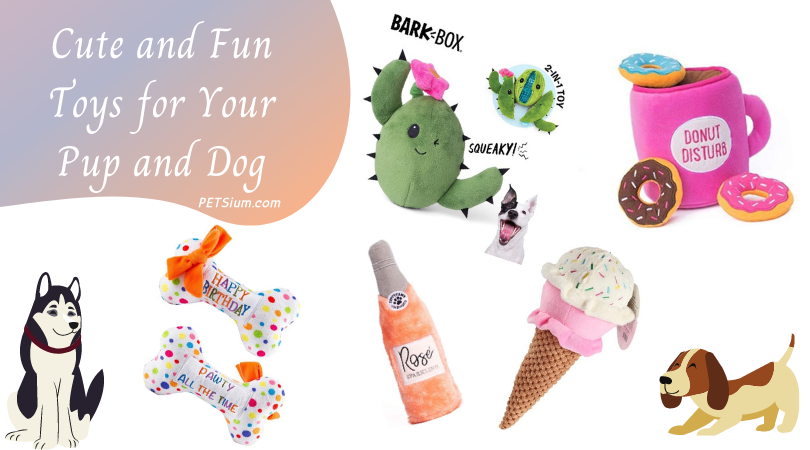
Cute and Fun Toys for Your Pup and Dog

When your dog is anxious or while being left alone, the cuddly companion will provide an outlet to their stress. During naptime or at bedtime, their soft toy will be a welcome addition to their soft bed. Regardless of your dog’s age, a plush dog toy is a perfect lifelong buddy.

Dog plush toys are a great gift but you need to consider the best toys that suit your dog? Take a look at these different toys and see what fits your pet.

BarkBox The Cactus 2-in-1 Dog Squeak Toys

BarkBox The Cactus Dog Toy

Buy on Amazon


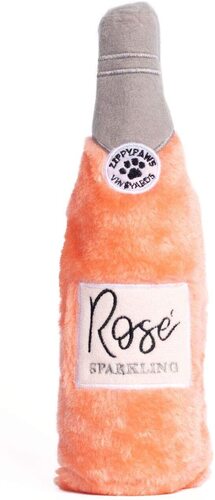
ZippyPaws Happy Hour Drink Themed Bottle Dog Toys

ZippyPaws drink themed bottle shape dog toy

Buy on Amazon


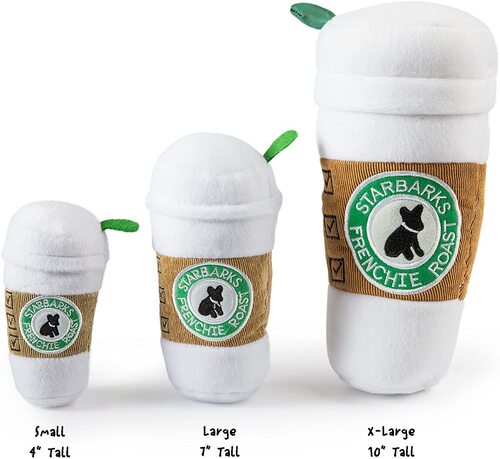
Haute Diggity Starbarks Coffee Collection Plush Dog Toys

Haute Diggity Dog Starbarks Toy

Buy on Amazon


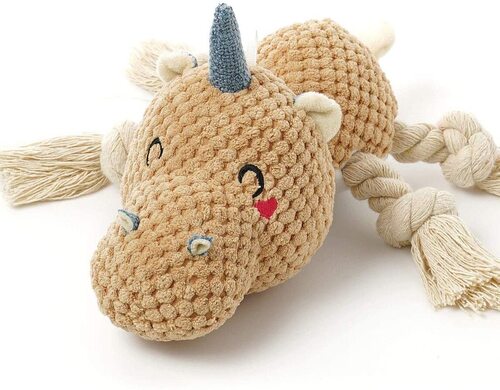
Sedioso Interactive Stuffed Dog Chew Toys

Sedioso Dog Plush Hippo Shaped Toys

Buy on Amazon


Haute Diggity Parody Hide and Seek Interactive Puzzles Plush Toys for Dogs

Haute Diggity Dog Toy Chewy Vuiton Trunk

Buy on Amazon


Haute Diggity Dog White Chewy Vuiton Bone Shaped Dog Toy

Haute Diggity Birthday Bone Dog Toy

Buy on Amazon


ZippyPaws Donuts and Coffee Interactive Hide and Seek Plush Dog Toy

ZippyPaws Coffee and Donut Dog Toy

Buy on Amazon


Petlou Durable Food Collection Dogs Plush Squeak Toys

Petlou Plush Food Collection Dogs Squeak Toys

Buy on Amazon


Bzonsmart Stuffed Durable Plush Dog Chew Toys for Small and Medium Dogs

Bzonsmart Stuffed Durable Plush Dog Toys

Buy on Amazon


Alirea 2pcs Soda Funny Drinks Plush Dog Toy

Alirea Soda Funny Drinks Plush Dog Toys

Buy on Amazon


MewaJump 3pcs Plush Cute Stuffed Dog Toys for Puppy, Small, Medium, Large, Dogs

MewaJump Eagle and Parrot Plush Dog Toys

Buy on Amazon


Hpets 3 Pack Funny Stuffed Plush Dog Chew Toys

Hpets 3 pcs Hamburger, French Fries and Shake Cup Plush Dog Chew Toys

Buy on Amazon


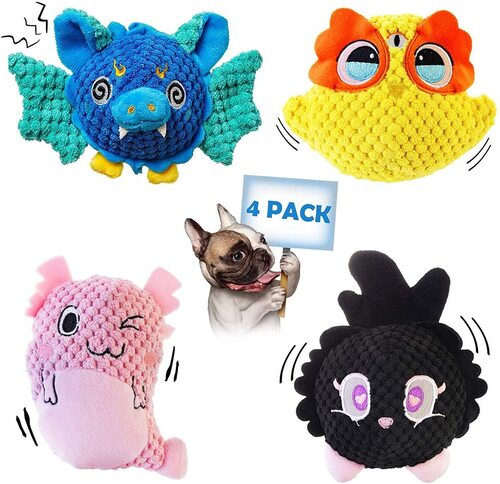
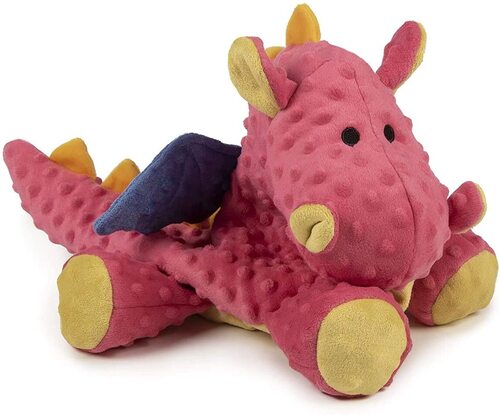
goDog Dragons Durable Plush Squeaker Dog Toy with Chew Guard Technology

goDog Dragons Durable Plush Squeaker Dog Toy

Buy on Amazon


Dogs wish to play. Giving them their own things to play with is a nice way to let them to spend a amount of their energy, and also avoid your things that they must not be chewing on. Simply like youngsters, all dogs do not like the identical dog toys. Some dogs like to play fetch, wile others like it very little rough and others have a softer side.

Dog owners do love to represent their dogs as their children. „That’s my boy“, they can say while pertaining to their own dogs. They will refer themselves as „Mummy“ or „Daddy“ whereas talking to the dogs as well.

People love to give cute and, squeaky toys to their dogs or get them stuffed toys to chew and carry it (the stuffed toy is that the dog’s „baby“ typically. As they think it’s „adorable“. Dog toys should be „cute“, also they should be practical, fun, durable, and importantly safe for the dog.

Some dogs enjoy playing with stuffed toys, while others will love chewing through them even more! If you’re not sure if your dog will love or destroy a stuffed toys, make sure to give it a stuffed toy while you’re there to supervise. This way you can make sure your dog won’t accidentally swallow some of the stuffing.

Stuffed Plush Dog Toys are fun and a great way to let your dog play. Burn up energy and play with your pet, purchase a stuffed dogs toys.

Категорије: Dogs

Young Horse Training Tips

новембар 10, 2020 By liv parmel

If you like horses then one of the most exciting experiences you can have is to train a young horse. If you are going to train a young horse, you need to have consistency, patience and tenacity.

Regularly a horse owner isn’t aware that they need to work with both the mare and foal for young horse training to be successful and typically just focus on training the foal. But, it is vital that you don’t forget the mare when training the foal because they are biologically and emotionally associated.

How to Train a Young Horse

Grow a Relationship

There are many parallels between a human infant and a young horse. Any infant species requires a relationship to be started as soon as doable. Young horses start to develop relationships with other horses aptly away in addition to any humans that are around them. The trainer needs to focus on developing this relationship as soon as the horse is born.

A excellent training method to consider is natural horsemanship, which focuses on transparent interaction with horses. Through this horse training method, a trainer can improve the effectiveness of their training by improving their ability to communicate with the horse. Foal imprint training the most run of the mill method that trainers use.

This is essentially a process that involves bonding young horses with their handlers the same way a mother imprints on her horse baby. The best way to develop a relationship with a new horse is by spending as much time as doable with them.

Early Halter Training

Training a young horse should focus on developing a foundation for future horse training. The main method of interaction for a mounted rider is difficulty. To help a young horse know difficulty from the very start you should start halter training sooner.

This can also help show a foal that you cannot get away when something scares them. This can help a foal to confront what scares them since the trainer can help establish boundaries.

Introduce New Things

When you train a young horse, it is a excellent thought to try to introduce them to something new each day. It doesn’t have to be something major, but can be something as small as taking them to an unfamiliar area, using a different brush or introducing a new horse or human to the area.

Some larger introductions you can make include a bath, picking the hooves, running clippers near the ears and trailer loading. Any of these activities can help a foal become desensitized and help them become less frightened with new experiences. By doing this the foal can start to learn that the trainer doesn’t want to harm them.

Go Slowly

At some point in your life, you have likely veteran sensory overload. Trainers need to know that young horses can experience this as well so it is vital not to push a lot of new sensations and experiences at once otherwise you will delay the training process.

Rather you want to limit the training to just fifteen minute increments. If a horse doesn’t accept the new experience within this time then you should come back to it the next day. Once a your horse turns a year ancient, you can increase training session durations to a half an hour.

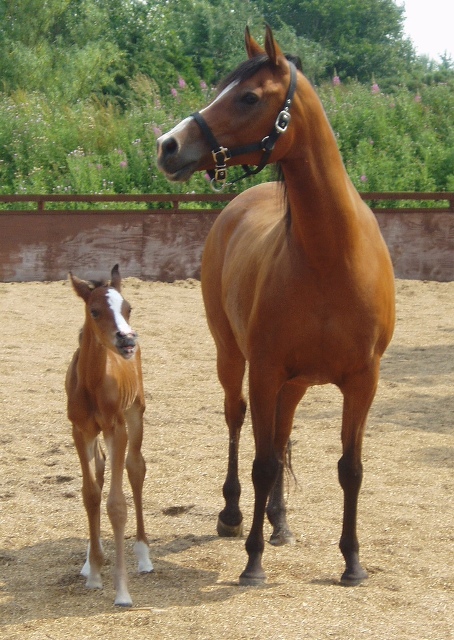
beautiful foal


Basic Horse Training Aids To Help You Get Started

All horse training is serious business. The average animal outweighs the trainer by an impressive margin, and the horse training aids you choose can help prevent serious injury.

Rope Halter

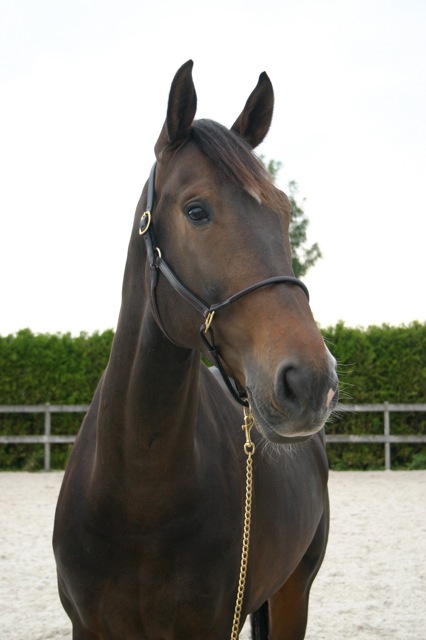
The most basic of horse training aids is the halter and lead rope combination. A rope halter will facilitate tying and leading, and works better than a flat halter because it will prevent leaning while at the same time being comfortable for the horse. The halter is placed on the animal’s head.

Lead Rope

The lead rope is attached to the halter and used to direct or “steer” the horse. In many ways this horse training aid is like a leash.

Lunge Line

The term lunging refers to the set of training skills used to teach a horse direction, posture, and how to yield or move off pressure. And the lunge line is the training aid used to accomplish this.

Progress String

In most cases, this horse training aid is a thin, braided rope with an eye splice at one end and leather “popper” at the other. This device is used in many ways.

You can apply a progress string as a visual aid. For instance, to let the horse know when he is in your space.

Also you can use this tool to make physical contact from the saddle. The progress string is not heavy enough to cause a horse any pain, but the popper end make s a distinct noise when applied, and can work in place of a crop.

Large Rubber Ball

Perhaps a less traditional horse training aid is a large rubber ball, like the kind you can buy at any toy store. This aid is great for conditioning the horse’s nerves.

You can roll the ball around in front of the horse, and even roll it gently into the horse’s legs. Also, while in the saddle, you can direct the horse into the ball and gently guide the animal to move the ball around with its legs.

This sort of training will help you desensitize your horse to unexpected movement and objects, thus decreasing the likelihood of getting spooked.

Plastic Tarp

Another tool for developing the horse’s courage, a common plastic tarp is an inexpensive and effective training aid. Start by laying the tarp out in the training area and leading your horse over it, or even asking the horse to walk over the tarp on its own.

As you know, a tarp can get pretty noisy when walked on. And it will create the illusion of strange footing.

You could even slowly work into an exercise where you place the tarp over your horse’s back, possibly completely covering him or her with the tarp. This not only develops the horses’ trust in you, it also simulates noisy brush and other riding situations and helps desensitize the horse to such conditions.

This list of horse training aids will give you plenty to work with in the beginning. Of course as training progresses you will need more advanced tools and tactics.

Training your young horse can be a wonderful experience and is simpler to do as you gain more experience. Handlers need to realize that mistakes are going to be made the first time, no matter which training method you choose to use. Once you find the aptly training method, you can continue to use it and start building on your experience.

Категорије: Horses

Horse Worms – What Every Horse Owner Should Know

новембар 4, 2020 By liv parmel

There are many types of parasitic worms that can find a home in a horse’s body. These worms can be harmful to the horse and make feeding and walking in the pasture a very miserable and a difficult experience. If a horse has too many worms in its body, it could die.

De-worming a horse once a year is recommended to ensure that worms will not survive to multiply and take over the horse’s body. Ask a veterinarian which medications the best for preventive de-worming. There are many on the market today that can kill one or more species of worm.

Horses contract worms from poor living conditions, other horses that have been mistreated, and from contaminated drinking water. Cleaning out stalls and refreshing water everyday is one way to prevent spreading the worms to the other horses living in the stable.

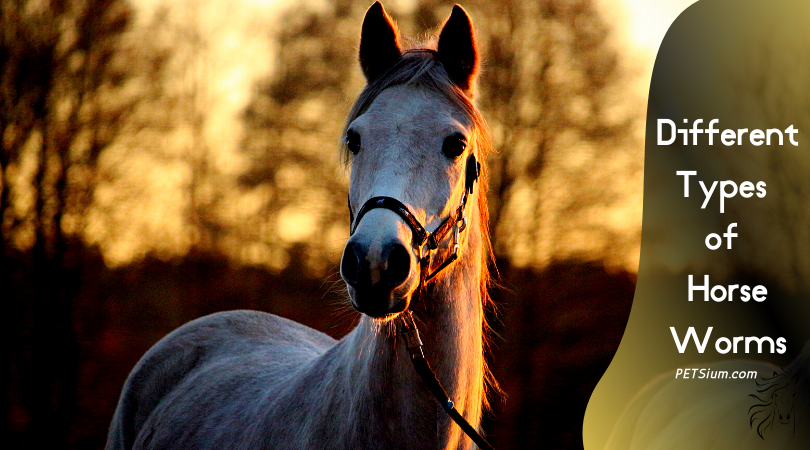
Different types of horse worms

The Most Common Horse Worms

One reason it’s so hard to eliminate horses from worms is that there are so many. There are more than 150 internal parasites that infest horses, and any or all of these worms can be in the horse at the same time. What’s more, it’s highly likely that different parasites will be at different stages of their life cycles. That means that a de-worming treatment that kills one species will have no effect on another. For that reason, a regular de-worming program is a must to maintain horses’ health.

Some most common types of worms that can affect a horse include Strongyle, Tapeworms, Ascarids, Bots, Pinworms, Threadworms and Lungworm. The first three can infect a horse through the feces of other horses. If a contaminated horse leaves feces on the ground and another horse steps on it and moves it around the rest of the stable, it will eventually get into the feed, grass, and into the water.

Strongyles Worms in Horses

Strongyles, which seem to affect younger horses the most, begin as larvae growing up in the arteries, gut wall, and liver. As they grow, they travel through the body heading for the large intestine where they will live out their lifespan. Once inside the large intestine, strongyles will feed of the digested food leaving little nutrients for the horse.

This can cause several problems. Stunted growth, intestinal problems, artery collapse, and eventually death are common in horses affected by strongyles. By separating the older horses from the younger horses, this parasite has less chance to infect the horses.

Large Strongyles

Large strongyles include bloodworms (Strongylus vulgaris) and large redworms (Strongylus equines and Strongylus edantatus). All are nematodes, and there are males and females in the species. Bloodworm larvae damage blood vessels supplying the intestines and other internal organs. The adult worms attach to the bowel wall and drain the horse of blood and nutrients, causing anemia, ill-thrift, colic, diarrhea and death. Foals are most susceptible to large redworms, but once infected and treated, they seem to develop immunity to the parasite.

Small Strongyles

Small Strongyles are the most common intestinal parasites in horses, and have displaced their larger cousins, Large Strongyles, as the greatest danger to horse health. This parasite alone comes in more than 50 different species, but about 10 of them are common. Small Strongyles are now aggressively treated, since they’ve been identified as the cause of a lethal disease known as larval cyathostomosis, previously referred to as larval cyanthostomiasis or “winter cyanthostomiasis”

Tapeworms in Horses

Tapeworms are usually uncommon in horses. They, too, are transferred by unclean stall conditions and through feces. Tapeworms can live for years inside the stomach lining of its host. But if many tapeworms gather in the stomach, this can cause blockage, which could cause the horse to die.

Tapeworms can be up to twelve inches long. They too keep a horse from receiving proper nutrients from food. There are many things horse breeders can do to prevent the spread of tapeworms. Rotating feed to make sure it is free of feces and clean out stalls often will prevent the spread of this parasite. Since the tapeworm is the least common of all parasites, if stalls are cleaned, infestation should not be a problem.

Keep in kind that getting rid of a tapeworm is far more difficult to deal with than contracting one. Tapeworms can grow back if the head of the worm is not removed with the rest of its body. Killing one with medicine takes time. The damage could already be done, so proper prevention is important.

Equine tapeworms look like flat triangles; they’re relatively short when compared to tapeworms in cats, dogs and humans, growing to about 8 cms long by about 1.5 cm wide. The tapeworm has a small, round head that attaches to the intestinal lining by four suckers. Horse breeders and veterinarians once thought tapeworms where relatively harmless, but that’s no longer the case. Recent research has shown that tapeworms are associated with certain types of colic, some of which can be deadly.

Ascarids in Horses

Roundworms, also known as ascarids, pose serious problems for foals and younger horses, but any horse can suffer with them. The parasite’s eggs can remain dormant in the soil for many years. Roundworm eggs hatch inside the horse’s gut. The larvae move through the walls of the small intestine and into the horses’ veins, where they’re transported via the bloodstream to the lungs. Once in the lungs, a horse coughs up and then swallows the larvae, which sends them back to the small intestine.

Ascarids are worms that affect the liver and the small intestine. These worms are similar to strongyles in that they affect younger horses. As with the other worms, proper cleaning of stalls is important in keeping infestation to a minimum. If not treated, the horse will probably die from colic or an aneryurism.

Horse Bots

Bots are transferred differently from the other worms. These worms transport by insects that land on the horse’s hair, such as flies. The horse ingests the eggs, which turn into larvae on the horse’s tongue. Eventually, the worms make their way to the stomach where they live on digested food and stomach acids.

This can result in a smaller, weaker horse that has not had the proper nutrients to survive. Bot eggs should be removed by cutting eggs out of the hair on the horse or by wiping them off with warm water. This will prevent the horse from digesting them.

Bots are the larvae of the bot fly. The female bot fly lays small, sticky, yellow eggs on the horse’s coat. When the eggs hatch, the larvae get into the animal’s mouth each time the horse licks its coat. The horse swallows the larvae, which then attach to the stomach lining. Eventually the larvae pass through the digestive system. When expelled, the larvae develop into adult bot flies in the horse droppings, and the cycle begins again. Bots damage the horse’s mouth and gums as well as the stomach lining.

Pinworms

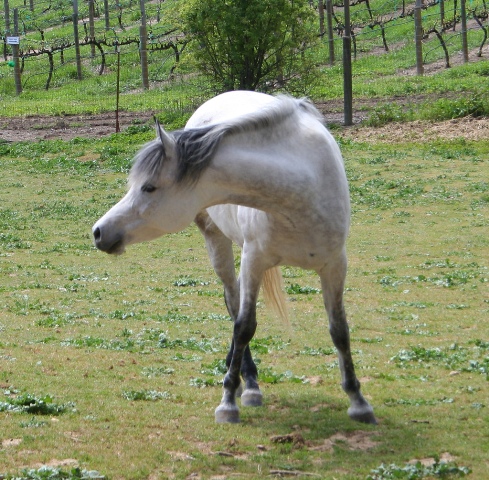
Pinworms live in a horse’s small and large colon. Females lay eggs around the horse’s anus in a sticky substances that irritates the animal. The eggs are removed when the horse excretes droppings. As with other worms, these eggs are deposited in the pasture where other horses eat them as they graze. Pinworms aren’t considered harmful but a large burden can cause severe irritation around the tail, which is maddening to the horse. Pinworms should be suspected if the horse is seen rubbing its anus against a tree, a fence or its stall.

Threadworms

Threadworms result when an infected midge bites a horse. Larvae deposited into the bite migrate to neck ligaments, suspensory ligaments and flexor tendons. Adult neck threadworms in the ligaments and tendons cause swelling and pain.

Lungworms

Lungworm larvae are among the many parasites than can infest horse pastures. When a horse eats infected grass, Lungworm larvae burrow through intestinal walls into the blood vessels that carry them to the lungs. Lungworm larvae irritate the small air sacs in the lungs, called bronchioles. This irritation causes breathing difficulties, severe cough and loss of appetite.

worms in horses

What Causes Worms in Horses

Horses have had parasites – worms – practically since equines evolved from their prehistoric ancestors. Most horse breeders, owners and veterinarians will say that it’s impossible to completely eradicate worms from horses, and that maybe that’s a good thing. However, it’s essential that anyone who cares for the health of a horse or horses recognize what causes worms in horses and what to do about it.

Since it seems impossible to eliminate worms completely from horses, it’s something of a relief to know that a small amount of horse worms – an amount termed a “burden” – usually doesn’t affect the horse’s health. What’s more, unlike worms affecting dogs and cats that can be passed on to humans (“zoonotic” worms), the parasites that affect horses rarely pass on to other species. They’ve become so specialized in their evolution that the only place these worms can live is in horses.

The drawback to these limits is that the horse domestication has led to large herds grazing closely together in fenced fields. This enforced closeness leads more quickly to contaminated feedstock and soil from which horses can be infected more easily.

The Life Cycles of Horse Worms

Mature worms lay eggs in the horse’s intestines. The eggs are shed in the horse’s droppings, falling into pastures where other horses graze. Another horse can ingest the eggs if it grazes close to the infected droppings. The eggs hatch inside the second horse and develop into adult worms capable of producing more eggs. While each species of worm has it own variation, this basic pattern is fairly consistent for all parasites.

Horse worms can be quite serious for young, old and sick animals. A regular schedule of de-worming for horses will help ensure that the parasite burden is kept within limits that won’t harm the animals.

Horse Worm Treatment and Control

Most horse owners invest large amounts of money and time in controlling, rather than treating, worms in horses. The reasons for this are simple, but frustrating:

Horses often have more than one type of worm. This means that more than one type of de-worming medication is needed, because not all worms respond to the same types of treatment.

A horse may show no signs of worm infestation until a severe episode of colic, diarrhea or weight loss occurs. By that point, the damage may be so severe that the horse will die.

Adult worms can be killed more easily than worm larvae, especially if the larvae have burrowed into the intestinal walls and become “encysted.” (Think of how caterpillars wrap themselves into cocoons to develop into butterflies). So it’s necessary to set up a regular “de-worming” schedule to catch successive generations of parasites.

As a result of these and other mitigating factors, treating worms in horses demands constant attention to three controls: cleaning pastures, scheduled treatment with de-worming drugs and diagnostic tests to determine heavily infected horses that can be dosed with stronger concentrations of worming drugs.

Pasture Cleanliness

Keeping down the parasite populations in horse pastures is a real chore. That’s because when infected horses drop their feces, worm eggs are deposited into the soil and onto vegetation that other horses consume, becoming infected themselves. Many species of parasites can lay dormant in their eggs in pastures for extended periods, developing into larvae when environmental conditions are good for their survival.

Research has found that regularly removing horse droppings from grazing pastures significantly reduces the risks of transmitting worms between horses. In addition, studies show that techniques such as pasture rotation, and grazing sheep or cattle on the same pasture, also reduce horse parasite populations. Sheep and cattle can eat horse worm eggs without becoming infected, so they act as natural controls on the parasites.

Scheduled De-worming Drug Treatments

Horse owners once dreaded de-worming their horses, because it mean inserting a nasogastric tube through the horse’s nostril, down its throat and into its stomach in order to administer de-worming medication. Now, however, new de-worming drugs come in oral pastes and feed additives, making it possible to treat horses for worms more easily. Tubing may still work best when a horse is diagnosed as heavily infected and needs a high dose of medication to kill off the worms.

What’s more, regular de-worming has been shown to kill off some 90 percent of adult worms. However, a drawback to this method is that it means treating horses that may only be minimally infested with worms. It also means that the horse owner must plan for a regular purchase of expensive de-worming medicines. In some cases, however, this may be the best way to control the worms where pastures have been found to been highly infested or horses seem susceptible to re-infections.

Diagnostic Tests

Given the prevalence of horse worms, horse owners and breeders for years have simply assumed that all their animals were infected and dosed them all accordingly. Today, however, veterinarians have been much more skilled at performing and interpreting diagnostic tests to determine the parasite burden (amount of worm infestation).

For instance, all it takes to identify the severity of adult redworm infestation is to do a worm egg count on a sample of a horse’s droppings. This method also diagnoses roundworm infestation. Tapeworms have been much harder to detect, but a new blood test for tapeworm infection has provide promising.

The use of diagnostic tests to target de-worming treatment is helping horse owners to spend less on medications, to delay or avoid the development of drug resistance in certain worm species, and to reduce the environmental impact that certain drugs have on pastureland.

Consequently, the best treatment for worms in horses is to control or prevent worm infestations as much as possible.

Horses must be kept in clean stalls that are refreshed every few days with new grass and hay. Drinking water should be changed at least once a day. Grooming horse often will prevent bots and other worms from getting into the horse. Young horses need to be separated from the older ones during pasture times if at all possible. This will prevent the spread of strongyles and ascarids.

Keeping all horses that live in the same stable together and not letting them graze with horses from another stable is a good idea. Since worms are easy to spread, proper precautions will make it harder to contaminate a horse.

Категорије: Horses

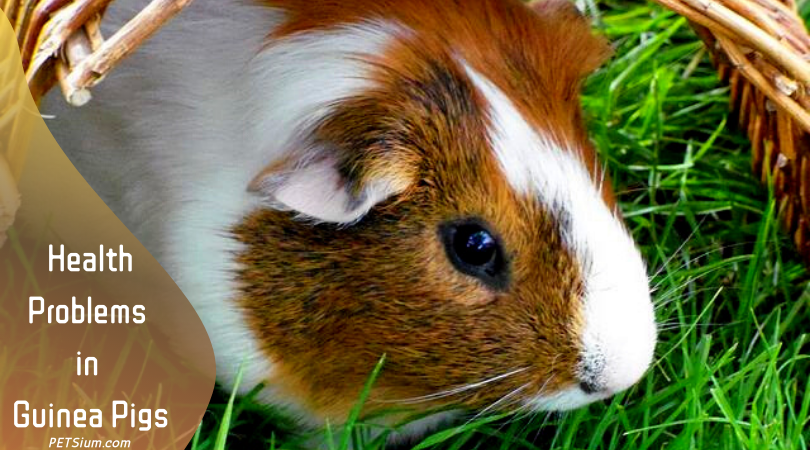
Common Guinea Pig Health Problems

октобар 27, 2020 By liv parmel

Guinea pigs are wonderful pets, but if there is a negative aspect to owning cavies, it’s their health. They are fragile creatures and more prone to illness then other domestic animals. As owners, we need to be aware of common ailments so that we can quickly get our pets the proper care and ensure they live a long and happy life. Here are some of the more common symptoms your guinea pig might exhibit.

Health Problems in Guinea Pigs

Wheezing or Labored Breathing

If you cavy is wheezing or is having difficulty breathing, he may have a respiratory infection, which usually results from congestion in the lungs. Get to a vet and get this treated as soon as possible, as it could easily turn into pneumonia.

Coughing

A constant cough can indicate a serious issue. If it is accompanied by wheezing, or labored breathing, you need to contact your vet. Chances are, it’s a respiratory infection of some sort.

Sneezing, Discharge of the Nose

A regular sneeze could indicate an allergy. It is not uncommon for guinea pigs to be allergic to certain kinds of bedding. Try changing the bedding and see if that clears up the sneeze. If your pet has some sort of discharge around his nose or you catch him rubbing his nose a lot, you should get him checked out.

Watery Eyes

Watery eyes often indicate an irritant in the eye, which could simply be excessive dust. Guinea Pig watery eyes could also be the result of allergies. Your vet can tell you how best to rinse the irritants out of the eye. Another possible cause of watery eyes are cysts on the eyelid which irritate the eyes. These can be painful and serious and they need to be removed by a trained veterinarian.

Scratching

Excessive scratching generally indicates either a fungal infection or parasites. To see if your guinea pig is infested with parasites, brush through his hair and inspect the skin. If your cavy has lice, you can recognize them as small brown dots. To get rid of lice, get a medicated shampoo from your vet and clean and disinfect the cage.

Pink or Red Urine

A pinkish or reddish color indicates blood in the urine and is quite serious. It often results from bladder stones. Get your guinea pig to a vet as soon as possible.

Milky-White or Sludgy Urine

A slight milky color is normal, but extremely clear or white urine is not and neither is overly sludgy urine. Any of these could indicate too much calcium in your cavy diet. Make adjustments accordingly.

Signs and Symptoms of Common Guinea Pig Ailments

Diarrhea or Overly Soft Stool

Diarrhea is very serious and can quickly lead to death if left untreated. Give your pet lactobacillus acidophilus in capsule form. You can get it over-the-counter from a pharmacy or at a health food store.

Most cases of diarrhea result from too many wet foods or vegetables. If you think you may have given your cavy too much of either, increase his intake of hay to promote a good digestive balance.

Tilting Head

If you notice your guinea pig tilting his head to one side and having trouble walking, he’s probably got a middle-ear infection. Take him to a vet to get this treated as soon as you can. It can lead permanent hearing damage or worse.

Hair Loss

Hair loss can result from a number of issues. If your guinea pig suffers a cut or is bitten, the hair around the injured area will fall out until the skin has completely healed. This is perfectly normal and nothing to worry about.

Hair loss could also be the result of mites, a ringworm or even ovarian cysts. If you cavy is losing his hair for any reason other than a minor injury, get in touch with a vet.

Stiff Joints

Stiff joints are usually caused by scurvy. Yes, scurvy. Just like the pirates, your cavy will get scurvy when he doesn’t get enough vitamin C. This needs to be treated immediately, so get your pet to the vet. Scurvy only occurs in cases of severe vitamin C deficiency, so it really should not ever happen. Make sure that your guinea pig gets around 25 mg of vitamin C a day.

Seizures

There are two types of seizures and both should result in a trip to the vet. If your guinea pig is tilting his head to one side during the seizure or is curling his body, any number of things could be the cause. Your vet will run blood tests to figure out what’s wrong.

If your cavy head shoots straight up in the air, with no tilt at all, that’s an indication of mites. These nasty parasites burrow under your pet’s skin and can potentially affect the nervous system. They are easily treated, so get your guinea pig to the veterinarian’s office and he’ll be just fine.

Have any of your cavies ever gotten seriously ill? What did you do? Let us know in the comments below!

Категорије: Guinea Pig

Mouthing, Biting and Nipping in Puppies

октобар 20, 2020 By liv parmel

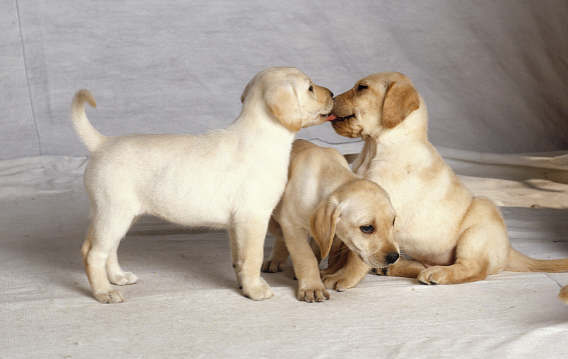
Mouthing, biting and nipping is a natural canine behavior that develops when a puppy plays with his mom and littermates. Because he has no hands, he learns to use his mouth to wrestle and play. When he nipped too hard, his fellow playmates let him know with a sharp yelp or cry, and puppy would normally back off.

Puppy biting and mouthing

While it may be acceptable within the ranks of a litter, mouthing and biting is NOT an acceptable form of play with people. Puppy teeth are sharp! And all puppies grow up to be dogs capable of inflicting severe damage to human skin, flesh and bone.

Biting and mouthing behavior in adult dogs can have deadly consequences. Not every dog is allowed one bite. Some dogs are euthanized immediately after their first biting incident – no exceptions. No second chance.

Every pup has a strong tendency to chew. Puppy biting, for your puppy, is fun, a way to play with their siblings or friends, and also sometimes to get your attention. It is a very normal tendency and it does not mean that your pup is aggressive.

It is seen that puppy biting is a tendency that your puppy will grow out of eventually. But, till then you will have to convey a message, through your voice as well as body language, that puppy biting will never be tolerated.

Puppy biting can be stopped by simple techniques. You can give lots of chewable toys to your puppy to chew on. A puppy, though young, needs a lot of exercise. Ensure that your puppy gets at least 45 minutes of play and exercise a day. You can also help your puppy socialize with other pups in your area.

Stop Bad Behavior Before It Starts

We often inadvertently encourage mouthing and nipping by playing with and/or praising our puppies excessively with our hands. If you want to play with your puppy, use a toy, not your hands, to simulate wrestling play behavior.

There are a myriad of ideas on how best to stop mouthing and nipping. We list some of these methods here but stress that there is no single right or wrong way to deal with this behavior.

Talk to your breeder, your veterinarian or a qualified dog trainer for advice on working with your specific breed of dog. If you have an adult dog that has problem with biting and nipping, seek professional help immediately!

Communicate Your Disapproval

Your puppy needs to learn about bite inhibition. Whenever he takes any part of you in his mouth, startle him by loudly and quickly saying “Ouch! No bite!” In doing so, you have vocally let him know the behavior is unacceptable. (Just like his mom and littermates used to do).

You Can Then…

  • Immediately stop playing, turn away, and ignore the puppy. When you face the puppy again and offer your hand, the puppy should ignore it or gently lick it. If he does this then quietly praise him.
  • If puppy wants your hand in his mouth, make it uncomfortable for it to be there! When he take hold of your hand, make a fist and stuff your hand in his mouth for several seconds or stuff your fingers toward the back of his throat. He’ll start to gag and spit and soon realize that a human hand doesn’t taste quite so good. When he lets go of you, immediately provide a suitable toy and praise him for being so clever as to choose the toy, rather than your hand.
  • Immediately grasp his muzzle with your hand, look him in the eye and say, „No Bite!“ The second he looks away from you, release his muzzle, and offer a toy instead.
  • A spray bottle filled with 1/8th vinegar and 7/8ths water may be effective for a puppy that is nipping at your heels. When he nips, say „Ouch! No bite!“ and spray him in the face with the spray bottle.

Repeat any of the above methods two or three times. If puppy still continues to mouth and nip then he is over stimulated and needs a time out – alone – in his crate. Remember the crate is a den, not a cage. It should be treated as a place of sanctuary, not punishment. Keep his crate clean and dry, with bedding to snuggle up in and one or two indestructible chew toys to entertain him.

a puppy play biting

Basic Training Guidelines:

• Remember, the above-mentioned methods are for very young puppies. These methods are NOT suitable for dogs older than about 12 weeks.

• Be consistent. Never allow the puppy to take your hands in his mouth.

Allowing the puppy to hold, mouth, or chew your fingers at any time makes it more difficult to differentiate in appropriate behavior from acceptable actions.

• Don’t play games that encourage hand/mouth contact or teach your dog to pit his strength against yours. (Tug-of-war and wrestling are out!)

• Don’t encourage puppy to chase people. (This is especially challenging to do with herding breeds!) Teach kids not to run around and excite the puppy.

• Don’t hold toys up in the air to encourage puppy to jump and bite at them. (He may accidentally nip your hand.)

• Don’t allow puppy to grab at or chew on his leash. Yes this can be cute behavior but it leads to other problems.

Don’t loose your temper! Aggression begets aggression.

puppies play time

The moment you bring your dog home for the first day, you cannot expect him to be trained and well behaved. With the passage of time you will realize that there are some dog behavioral problems that you need to rectify in your new pet and very often, one such common problem that many dog owners face is dog nipping.

Dog nipping should not be encouraged and there are ways and means to teach your dog on how to stop nipping the moment you notice him doing so. The first thing that you can do when you are checking the dog nipping habit in your dog is stop playing with him. Every dog loves to play and the nipping habit is generally developed when they are playing.

You should remember that the moment the dog nips you during the playing session you should stop playing so that the pet can connect this to his nipping. The moment he makes the connection he stops the dog nipping habit. You need time and patience for your dog to understand this and you should not expect overnight results.

Dog nipping is mostly done on fingers and when your dog starts nipping you must redirect his mouth to another object preferably a dog toy that will help it reduce this habit. There are many dog toys that are available in the market for the purpose of dog nipping and all you need to do is get hold of a good one and offer it to your pet the moment he nips. The moment he starts to chew on the toy you should praise him so that he understands that he is doing the right thing.

Категорије: Dogs

Horse Names – 270+ Names For Your Unique Horse

октобар 13, 2020 By liv parmel

Whether you are thinking of getting or have already got yourself a lovely horse, you will have various things on your to-do list. You will have to learn how to properly care for it, know the number of times it should be fed or taken for exercise in one day or how to give it proper grooming. However, those are certainly not the first problem to tackle, because deciding your horse’s name is!

Horse Names

As with any other pets, naming is often a difficult task as naturally you would want the best name for your new family member. You can relax because we will now provide you with some naming suggestions and a top list of good horse names!

Now check out our list of really good female horse names and male horse names that are most popular at the moment to pick the best one for your beloved four-legged friend!

Female Horse Names

  • Rosie
  • Ruby
  • Bella
  • Molly
  • Poppy
  • Tilly
  • Millie
  • Lady
  • Lucy
  • Bonnie

Male Horse Names

  • Jack
  • Charlie
  • Billy
  • Harry
  • Bailey
  • Alfie
  • George
  • Murphy
  • Bobby
  • Paddy

Funny Horse Names

  • A Tail of Intrigue
  • Atom Ant
  • Baba Looey
  • Bamboozle
  • Blonde Logic
  • Blueberry Stirrup
  • Bridle of Frankenstein
  • Bridle Party
  • Bridle Veil
  • Buckmeister
  • Buckorama
  • Bugs Bunny
  • Cant be Trusted
  • Carrot Connection
  • Celebrity Impersonator
  • Classical Gas
  • Colt Forty Five
  • Comic Relief
  • Cookie Monster
  • Cousin It
  • Cow Belle
  • Designer Genes
  • Designer Knockoff
  • Dinner Belle
  • Dirt Devil
  • Dohickie
  • Dot Calm
  • Dust Devil
  • El Kabong
  • Electric Banana
  • Electric Gait
  • Fashionably Late
  • Flat Broke
  • Gait Code
  • Gait Keeper
  • Gaits of Heaven
  • Gaits of Hell
  • Galloping Gourmand
  • Galloping Gourmet
  • Garden Gait
  • Glacial Pace
  • Gone Bananas
  • Hypno Toad
  • Invisible
  • Genius
  • Looney Toons
  • Mane Line
  • Maple Stirrup
  • Miss Behave
  • Missile Toes
  • Morbo
  • Mr Knowitall
  • Mucho Mula
  • Nibbler
  • Pasterella
  • Pearly Gaits
  • Popsicle Toes
  • Redonkulous
  • Rein Dance
  • Royal Rein
  • Scooby Snack
  • Secret Squirrel
  • Security Gait
  • Sneaky Pete
  • Snidely Whiplash
  • Snorgle
  • Sotally Tober
  • Spider Pig
  • Star Grazer
  • Starving Artist
  • Status Symbol
  • Storm the Gaits
  • Sugar Lips
  • Thingamajig
  • Thigh Master
  • Top Banana
  • Twinkle Toes
  • Wackadoodle
  • Zap Branigan

Race Horse Names

  • Acceleration Force
  • Acrostar
  • Allegro
  • Blockade Runner
  • Bullet Train
  • Comet
  • Dart
  • Escape Velocity
  • Feet that Fly
  • Final Velocity
  • Fireball
  • Flash Drive
  • Flash Fire
  • Flashback
  • Full Sail
  • Hasty Pudding
  • High Speed Chase
  • Hyper Drive
  • Jet Stream
  • Jet Wash
  • Joy Ride
  • Light Speed
  • Max Acceleration
  • Maximum Impact
  • Pony Express
  • Whistle
  • Wink
  • Radial Velocity
  • Rapid Fire
  • Rapid Transit
  • Reckless Speeder
  • Record Breaker
  • Road Runner
  • Rocket Fuel
  • Shock Wave
  • Shooting Star
  • Shortcut
  • Silver Arrow
  • Silver Bullet
  • Solar Wind
  • Sonic Boom
  • Sonic Flash
  • Speed Demon
  • Speed Indeed
  • Speediac
  • Speedy Deed
  • Speedy Gonzales
  • Starlight Express
  • Straight Arrow
  • Swift Justice
  • Swift Kicker
  • Swifty
  • Swish
  • Terminal Velocity
  • Thrill Ride
  • Time Traveler
  • Tornado Buster
  • Whiplash
  • Whirlwind
  • Wind Rider
  • Wings of Glory
  • Zipper

Horse Names Related to Magic and Dreams

  • Allakazam
  • A Little Magic
  • Abracadabra (a word magicians use to suggest a magic change).
  • Alchemist
  • Alchemy
  • Amulet
  • Bibbity Bobbity Boo
  • Card Trick
  • Day Dreamer
  • Daydream Believer
  • Dreamgirl
  • Dreamcatcher
  • Dreams of Glory
  • Dreams of Victory
  • Dreamweaver
  • Dreamy
  • Escape Artist
  • Fairy Dust (an essential tool for fairies).
  • Falling Star
  • Gandalf (J.R.R. Tolkien’s wizard from The Hobbit and The Lord of the Rings series).
  • Gloriana (the fairy queen from a 16th century English epic poem by Edmund Spenser).
  • Harry Trotter
  • Hermione
  • Hocus Pocus
  • Houdini
  • Illusionist
  • Impossible Dream
  • Incantation
  • Lucky Charm
  • Charm
  • Magic
  • Magic Carpet Ride
  • Magic Flute
  • Magic Trick
  • Merlin (King Arthur’s aide).
  • Miracle
  • Mr Sandman
  • Revelation
  • Spell
  • Sirius Black
  • Soothsayer
  • Sorcerer
  • Sugar Plum Fairy
  • Suspended Belief
  • Sweet Dreams
  • Tinkerbell (fairy from James M. Barrie’s book Peter Pan).
  • Talisman
  • Titania (the fairy queen in Shakespeare’s A Midsummer Night’s Dream)
  • Zodiac
  • Wonder

female horse names

Western Horse Names

  • Abilene
  • Alamo
  • Ambush
  • Amigo
  • Apache Brave
  • Bandido (bandit in Spanish).
  • Bandit
  • Bandolero (another name for bandit in Spanish).
  • Bat Masterson
  • Billy the Kid
  • Butterfield (the name of a stage coach line in the American west).
  • Chester
  • Cheyenne
  • Chief
  • Chief Buffalo Hump (a Comanche chief).
  • Cimarron
  • Dakota
  • Denver
  • Deringer
  • Desperado
  • Diamondback
  • Drover
  • Durango
  • Dusty
  • Geronimo
  • Ghost Rider
  • Gold Rush
  • Gun Fighter
  • Gun Slinger
  • Gunfight
  • Gunplay
  • Gunsmoke
  • Jack of Diamonds
  • Laredo
  • Lone Ranger (He was a Texas Ranger. Lone Ranger’s horse name was Silver).
  • Mirage
  • Marshal Dillon
  • Maverick
  • Outlaw
  • Peace Pipe
  • Pecos Pete
  • Quick Draw
  • Rattler
  • Red Sky
  • Reno
  • Ricochet
  • Rio
  • Rough Rider
  • Rowdy (Clint Eastwood played Rowdy Yates in the TV western, Rawhide).
  • Roy Rogers
  • Rustler
  • Santa Fe
  • Sarsparilla
  • Scout
  • Sedona
  • Sheriff
  • Showdown
  • Sidewinder
  • Sierra
  • Silver Bullet
  • Smoke Signal
  • Six Shooter
  • Stampede
  • Sunset
  • Tex
  • Texas Ranger
  • Texas Star
  • Tin Star
  • Tomahawk
  • Tombstone Rose (the largest rosebush in the world is in Tombstone, Arizona).
  • Tonto (Tonto was the Lone Ranger’s Native American partner. In the TV series of the 1950’s the character was played by a Mohawk named Jay Silverheels).
  • Trail Blazer
  • Trail Boss
  • West Wind
  • Whisky
  • Winchester (the gun that won the West).
  • Zorro


funny horse names

Female Horse Names Inspired by Flowers

  • African Daisy
  • Anemone
  • Blackeyed Susan
  • Bloom
  • Blossom
  • Bluebell
  • Buttercup
  • Camellia
  • Cherry Blossom
  • Dahlia
  • Daisy
  • Dandelion
  • Flower
  • Ginger
  • Heather
  • Hollyhock
  • Honeysuckle
  • Hyacinth
  • Iris
  • Jasmine
  • Lavender
  • Lily
  • Lily of the Valley
  • Lotus
  • Marguerite
  • Marigold
  • Mimosa
  • Morning Glory
  • Pansy
  • Passion Flower
  • Peony
  • Petunia
  • Posie
  • Queen of the Night
  • Rose
  • Rose of Sharon
  • Rosebud
  • Rosie
  • Snapdragon
  • Snowdrop
  • Star Flower
  • Star of Bethlehem
  • Sweet Pea
  • Tiare
  • Tiger Lily
  • Toad Lily
  • Tombstone Rose
  • Touch Me Not
  • Tulip
  • Viola
  • Violet
  • Windflower
  • Yellow Rose of Texas
  • Zinnia

There are more than one ways to find a good name for your horse. First of all, you can try to create a unique name for it by yourself. You can name it after your favorite actor or actress, some objects that you like, a word that reminds you of a happy memory, or just about anything that reflects your hopes or your personalities.

It is more common for horse owners to name their pet according to its physical traits or temper. For example, a horse with beautiful jet-black hair can be named “Darkie”, and a gentle and elegant female horse may be called “Duchess”. You can search for white horse names if you have a white coated horse or you could search for black horse names if he is darker. In this way, you can think of many horse names for your new friend.

Nevertheless, if you still cannot choose any good name on your own, you can just take a look at our horse name list and pick out one that you think is most suitable. Whether yours is a mare, colt, stud or gelding, male or female, you will find a perfect name for it here.

Believe it or not, the most popular and most-loved horse names recently are often traditional ones and not the exotic or extraordinary ones. This must be because most people think of their horses as real family members and therefore would want to give them more humanlike names.

As a result, more and more horses go by good horse names such as Charlie, Bella, Jack, Harry or Molly, reflecting that they are part of the family.

If yours is a girl horse, you might want names with the ‘e’ ending sound, such as Rosie, Poppy, Lady, Lucy or Bonnie. These kinds of name often sound nice and girly enough for your little girlfriend.

On the other hand, if yours is a boy horse, your best choices are usually traditional humanlike names that are clearly meant for boys. For instance, you can name him Billy, Bailey, George, Bobby or Paddy. Check out our male guinea pig names for more unique name ideas.

You can also get some fun horse name ideas from our guinea pig names page. Although those names are not meant for horse they sound great and could be used as horse names anytime as well.


Категорије: Horses, Name Inspiration

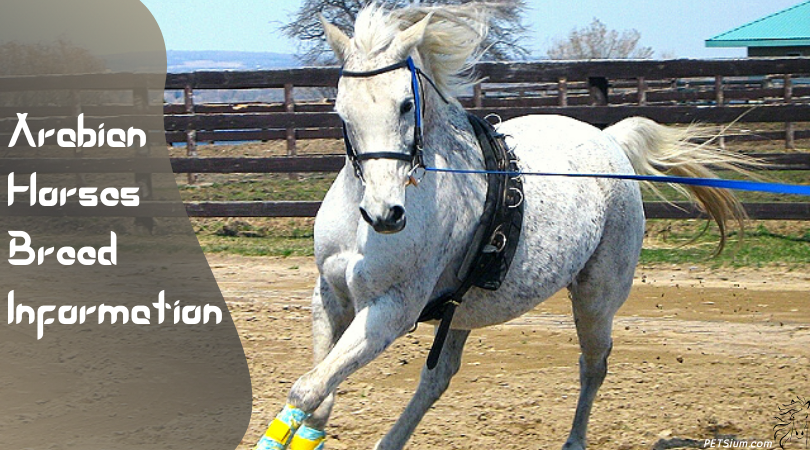
Arabian Horse Facts, Colors, Temperament

октобар 6, 2020 By liv parmel

The Arabian horse is probably one of the most recognized and famous breeds of horse in the world.

This is due to a number of factors including its extreme beauty, high intelligence and the fact that it is considered to be one of the oldest breeds in the world.

Arabian Horse

The Arabian horse is a noble warm-blooded animal, which derives its origin from the original form of the Tarpan.

Arabian Horse Origin

The name alone says that his homeland is Arabia. The Najd plateau (1000m above sea level) is located in the western part of Saudi Arabia and is considered the homeland of Arabian Horses.

Some believe that the Arabian Horse is descended from the Tarpan Horse.

Originally found in the Middle East, the breed quickly attracted the attention of riders around the world and soon the breed had spread to eventually be found in almost every country as well as virtually every horse bloodline on the face of the earth.

The steppe climatic conditions imposed a very ruthless natural selection of the Arabian Horse.

In such conditions, a horse of shorter stature, solid construction, modest needs in food and water was created.

Arabian Horse Appearance

The Arabian Horse is square in shape, with a characteristic broad head throughout.

His eye sockets lie deeper in the skull, are oval and have sharp edges.

The eyes are large, expressive and bright.

Ears small and distinctly erect.

Legs short, with strong tendons and extremely strong ankles.

His movement is sharp and strong, both in walk and in the trot.

Its tail is set high with strong musculature at the root of the tail. It moves easily and belongs to the group of fast horses.

The Arabian Horse belongs to the category of lower horses, with a height of 148 to 153 cm, a chest circumference of up to 170 cm, a shin of 18.5 cm and a weight of 400-420 kg.

It reaches full maturity at the age of 5 to 6 years.

Most Arabian horses are traditionally shorter than other breeds, however more recently, they are being bred to include an element of height that may bring an overall increase of as much as one or two extra hands.

Arabian Horse Ability

One of the reasons that riders and breeders love the breed of the Arabian horse is because of its seemingly endless talent and ability.

Known for being agile, versatile, athletic, high-spirited, intelligent and graceful, Arabian horses are used in many different types of activities and events such as saddle riding, showmanship, sports and work-related activities, affording it the name, „The Versatile Arabian“.

Arabian Horse Temperament

The Arabian horse seems to have something of a dual nature, being naturally good with humans as well as adept at aggressive activities, being often used in times of war because of its alertness and quick response.

Most owners of an Arabian horse treat the breed with as much dignity and respect as would be afforded to a human.

The breed’s sensitivity and intelligent seem to give the impression that they have many human-like qualities such as sensitive feelings, a high level of competence and a sort of empathy and understanding.

Arabian horse colors

Arabian Horse Colors

Arabians are not specific to any one color, being found in a wide range of shades and patterns, however black skin, except where there are white patches of hair, is found on all Arabian horses that are pure bred.

Despite the fact that a purebred Arabian horse may come in any number of shades and colors.

Only certain ones are officially recognized by the Arabian Horse Association – roan, chestnut, grey, bay and black – which the color that is most popular and least commonly found, due to the fact that is considered to be a recessive gene.

However, the black Arabian horse is becoming more readily available as DNA breeding methods are used that allow breeders to choose the black color option.

This new breeding method, although unnatural, is actually not too far outside of the origins of the first Arabian horses, as far as history can ascertain, as it is believed to be not only one of the oldest breeds in the world, but also is a man-made or human-developed breed.

Today, the most common use for an Arabian horse is in competition, which follows in line with one of the earliest intents for the breed.

Because the breed tends to excel in sports, they are often pitted against many other breeds to see who will be the last to stand.

Категорије: Horses

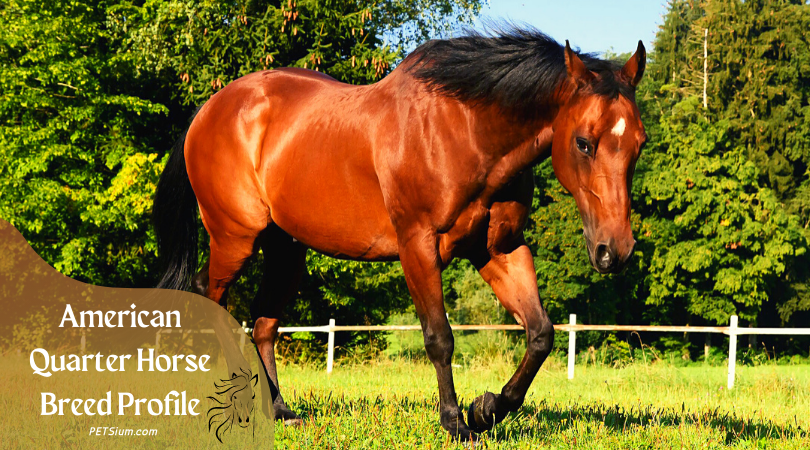
American Quarter Horse Breed Information

октобар 1, 2020 By liv parmel

The American Quarter Horse, also known as the Quarter Horse, has gained world-wide recognition and respect for being one of the best, if not the absolute standard-setting, short distance racing horses in the world. In the United States, this breed, which has been known to reach speeds in excess of 55 miles per hour, is the most popular and in great demand.

American Quarter Horses Information

American Quarter Horse

The Quarter Horse is a breed from the United States that is best known as a sprinter who can run short distances. This is the most popular breed of horse in the entire country and the AQHA has millions of horses registered. These horses are not just race horses, but are also used as rodeo horses, ranch horses and show horses. This horse features a compact body that lends itself perfectly to the agility required for various western riding tasks. These horses are used for roping, reining, cutting, herding and more. They excel in the show ring or at the ranch.

Abilities of American Quarter Horse

Although the breed excels in racing and short distance speed runs, the American Quarter Horse is also a frequently used breed for rodeos, ranching and other physically demanding work. The American Quarter Horse was given its name based on the quarter mile run that the breed seemed to excel at during races when pitted against other breeds.

The body of the American Quarter Horse is compact and well-muscled; however one of the abilities it is best known for it agility in maneuvering and quick timing. For example, in events such as calf roping, western riding and cattle-related exercises, the Quarter Horse is especially agile and proves to be an intelligent and very sensory companion to its rider.

What Are Quarter Horses Used For

Besides racing, American Quarter Horses are now used for ranches and rodeos. This breed is known to make a good herding horse capable of directing livestock. Cattle roping and barrel racing are just two more talents of this wonderful breed. The American Quarter Horse has brilliant physical and temperament characteristics. Not only is the breed strong and fast. It is very calm, which allows it to be used in recreation for children.

Because of its many natural capabilities and skills, the Quarter horse has grown to become the animal that is bred it the largest number all over the world. Currently, there are over 3.2 million Quarter Horses registered as pure bred.

American Quarter Horse – History

This horse originated in colonial times when English Thoroughbreds were crossed with Native American horses to produce this breed. The name of the breed came from the distance of race at which it did best. In the Old American West, this horse was used primarily by cowboys and ranch hands for work purposes. Although some tasks have been taken over by machines these days, these hardworking horses are still found working on ranches and farms as well as in the equestrian show ring.

American Quarter Horses Origin

The origins of the breed can be traced to Native American horses, such as the Mustang, bred with European horses brought over to the New World when the Americas were first being settled. Breeders soon noticed that the new breed of horse seemed to have a more innate sense of other animals, such as cattle, than other working breeds. Perhaps this was due to its wild roots from the feral breeds.

Because of this seemingly inborn sense, the Quarter Horse grew rapidly in popularity among ranchers and those settling the Western lands of the US. It was cattle ranchers who played the biggest role in spurning the breed on throughout the following centuries.

The American Quarter Horse Association was eventually formed in the early 20th century by ranchers and cattlemen who had worked to continue the breeding lines. After the formation of the group in 1940, a standard was established by which to identify pure bred – being those who displayed the many characteristics of the breed in an exemplary manner.

American Quarter Horse

Because the American Quarter horse was often crossed with the Thoroughbred breed, the American Quarter Horse Association also makes an allowance for the inclusion of this breed in its registries. Although this allowance has been beneficial in some ways, there are those who believe that the most original characteristics of the first breeds of American Quarter Horse are slowing being phased out or watered down because of the frequent crossings with the Thoroughbred breed.

Quarter Horses Characteristics

These horses are beautiful, finely muscled and strong yet compact of body. They have small heads with straight profiles. Their chests are broad and their legs are lean. The average height is between 14 and 16 hands although some may grow larger. Body types come in two variations: stock and hunter. Stock horses are shorter, quite agile and more compact yet still strong. Hunter types look more like racehorses and bear a resemblance to the Thoroughbred breed of horse.

The American Quarter horse has a compact, muscular body, however it is not generally a small-sized horse. Some Quarter horses have grown to be as many as 17 hands high, although there is one strain of the breed, the stock horse, that is typically much shorter than the racing strain of the Quarter Horse breed.

American Quarter Horses have a deep and roomy chest and muscular front legs, which are set widely apart. The muzzle is short, jawbones are big and clearly cut, and eyes placed well apart. Ears are not very big, and they have pointed tips. Neck is powerful, sloping into straight and tough back. The underline tucks up near hind legs, and the rump is muscular. That is why most of Quarter Horse photographs present backside views of the animal.

American Quarter Horse Colors

The breed has limited white markings on the face and on the areas below the knees. Sorrel color is considered the most common in American Quarter Horses. The breed may also come in black, brown, bay, chestnut, red, and other colors. You might be interested in some Horse names ideas for your American Quarter. Maybe black horse names will suit them the most.

Quarter Horses Conclusion

American Quarter Horses are very popular in the United States and around the world.

The American Quarter Horse is an outstanding breed. Racing enthusiasts have always valued its qualities. However, with the development of railroads, the breed was likely to lose most of the working qualities. This did not happen thanks to the American Quarter Horse Association that took care of the welfare of the breed. Nowadays, American Quarter Horses are promoted by a great number of clubs and associations both in the United States and worldwide.

Категорије: Horses

How long do Horses live?

септембар 26, 2020 By liv parmel

How long does a Horse live? Many factors contribute to the lifespan of a Horse. Good nutrition is necessary for a Horse (or any living creature) to live a long healthy life. When nutrition is lacking the Horse is more vulnerable to disease and slower to heal if injured.

How long does a Horse live

How Long Does A Horse Live In The Wild

The lifespan of a Horse in the wild is about 19 years. Domestic Horses usually live quite a bit longer.

How Long Does A Horse Live In Captivity

The average lifespan of a domestic Horse is 27 to 28 years, though I have known Horses who have lived into in their thirties and forties.

How Long Do Ponies Live

Ponies live on average 20-30 years, just as the Horse. Although Ponies usually live a bit longer than Horses. If you take good care of your Ponies they can live up to 40 years and possibly more.

How To Improve Lifespan Of A Horse

A conscientious owner will take care that their pet’s physical needs are all met. In addition to nutrition, hoofs need to be kept trimmed so that infections do not occur. Living quarters need to be cleaned often of manure and moisture to prevent hooves problems and to control the worm population.

Protection from extreme weather is important for your Horse’s health as is making sure that your Horses surroundings are free from objects that he/she could be injured on. A few trees in the pasture will provide shade in the summer and wind protection in colder seasons. Horses should always have access to a protected area such as a run-in shed.

Addressing stress and behavioral problems are also important for your Horse to live a long life. If a Horse cribs (chews on) and ingests wood from fencing or in his/her stall, the ingested wood can pierce the intestines and possibly cause death. A Horse that has high energy and is not exercised may become over-stressed, act out and injure himself/herself.

Visits with the vet are needed to keep your Horse safe from rabies, and diseases such as, West Nile Virus, Eastern Equine Encephalomyelitis, Western Equine Encephalomyelitis and more. The healthier your Horse is, the more chance it has to overcome any illness or injury that may present itself.

How To Help Your Horse Live Longer

Routine Checks

As strong and impressive as Horses are, they need to be looked after in order to maintain their health and vigor.

Routine checks are the easiest way to ensure that your Horse is doing well. Foot problems can not only hinder your Horse’s mobility, but can also cause greater damage to its health as a whole.

The teeth need to be checked regularly as well. An animal as big as a Horse needs to be able to eat as much as it needs, and dental problems can threaten to restrict its nutritional intake.

Taking the time to examine your Horse on a frequent and regular basis will not only help your Horse, but your vet as well.

With regular checks, problems that require medical assistance can not only be avoided, but also caught early. That way, any treatments will be less extensive. This will ensure a long and happy life for your Horse.

how long does a horse live

Dental Health

Grazing Animals

Horses are grazing animals, and their teeth have adapted wonderfully for that purpose. The front teeth, incisors, shear off forage. The cheek teeth, including the molars and premolars with their wide, flat, graveled surfaces, grind the feed to a mash before it is swallowed.

Floating

When the Horse’s teeth are rasped or filed down it is known as floating. Floating removes sharp enamel points and creates an even bite plane. It also keeps incisors and cheek teeth at a desirable length.

Some signs of dental problems include:

• Loss of feed while eating
• Difficulty while chewing
• Excessive salivation
• Loss of body condition
• Undigested feed in manure
• Head tilting and tossing
• Foul odor from mouth or nostrils
• Swelling of the face, jaw, or mouth

Lack of proper dental care may cause:

• Sharp points on teeth, causing cuts on cheeks and tongue
• Baby teeth that haven’t been shed
• Discomfort with bit contact
• Hook formation
• Lost or broken teeth
• Infected teeth or gums
• Gum disease

Foot Health

It is incredibly important to properly take care of your Horse’s feet. They are the lifelines of the Horse. Major arteries run through them and every time the Horse takes a step, it increases the flow of circulation throughout the whole Horse. The actual grooming aspects of hoof care are covered in grooming, but some of the adverse effects of improper or negligent hoof care are expanded upon here.

Conditions to look for:

• Puncture wounds
• Thrush
• Sand, heel, and quarter cracks

All of these conditions will need proper cleaning and treatment as soon as they are found.

General Signs the Hooves Need Checking:

  • Consistent pointing of a certain foot.
  • One hoof being constantly warmer than the others.
  • Increased pulse pressure.
  • Changes in hoof shape.
  • Discomfort when pulling or re-nailing a shoe.
  • Degree of motion is exaggerated when turning in small areas or on hard surfaces.

How Long Does A Horse Live Factors

A Horse can, if well cared for and used moderately, live to be 20 or more years old. Cases of 50-year-old Horses are also known! Older Horses are known for their increasing thinness of the head, for the penetration of the eyes into the eye sockets, for the appearance of white hair above the eyes, around the temples and harness bones, and for the lowering of the lower lip. The teeth in old Horses are worn, and sparse.

Genetics also play a role in aging – Ponies, on the whole, live longer than Horses, and certain breeds of Horses (like Arabians) have a reputation for living longer lives.

Though definitely not the norm, Horses can live to be over fifty years old. It is our job to make sure that their years on this earth are happy and healthy ones.

Категорије: Horses

  • « Go to Previous Page
  • Страница 1
  • Interim pages omitted …
  • Страница 5
  • Страница 6
  • Страница 7
  • Страница 8
  • Страница 9
  • Interim pages omitted …
  • Страница 22
  • Go to Next Page »

Primary Sidebar

Small Fish Tank

Glass Fish Tank

Категорије

  • Animals
  • Birds
  • Cats
  • Dogs
  • Fish
  • Goldfish
  • Guinea Pig
  • Hamster
  • Horses
  • Name Inspiration
  • Parrot Pet
  • Rabbits
  • Reptile Names

Скорашњи чланци

  • Hoppy Naming! Adorable and Funny Easter-Inspired Guinea Pig Names
  • Purr-fectly Adorable: Valentine’s Day Cat Names for Your Feline Friend
  • Astronomy Inspired Cat Names
  • James Bond Cat Names: Purr-fectly Suave Options for Your Feline 007
  • 170 Authentic Greek Names For Cats
  • Hippie Cat Names
  • Ladybug Facts For Kids
  • Unique White Horse Names with Meanings: From Majestic to Mystical
  • Disney Turtle Names: 160+ Names For Turtles From Disney Movies
  • 100+ Names For Black Horses With Meanings

Guinea Pig Cage

Large cage for your guinea pig

Ознаке

Best family parrots Best Gifts for Cat Lovers Best Hamster Toys Best parrot for beginners Best parrot for kids Best Small Dogs For Kids Boy Cat Names Can Guinea Pigs Eat Celery Cat Names Cat names for pairs Dog Behavior Dog Throwing up Dog Vomiting eat Female Bengal Cat Names Female guinea pig names Funny goldfish names Goldfish aquarium Goldfish names Gold Fish Names Goldfish tank Goldfish varieties Guinea Pig Guinea pig names Guinea pigs Male guinea pig names Manx Cat Names Names for Goldfish Names for guinea pigs Names for pink fish persian cat personality Siamese cats Small curly haired dogs Small dog breeds Sounds Twin cat names Types of goldfish Undigested food Unique guinea pig names What can guinea pigs eat Winter White Hamster Care Winter White Hamster Colors Winter White Hamster Diet Winter White Hamster Facts Winter White Hamster Life Span

Disclaimer:

This website „PETSIUM“ is not liable for any outcome or damage resulting from information obtained from these articles.

The articles provided here are for information and entertainment purposes only. The decision to use, or not to use, any of this information is the sole responsibility of the reader.

Any medical related content in any articles is not intended as diagnosis, treatment or prescription. It is not intended to be a medical advice and is not a substitute for professional medical advice. Please consult with a licensed health care practitioner if you are dealing with a serious medical problem.

Hamster Cage

Hamster Cage

Footer

Petsium – Veštačka Inteligencija

Dobrodošli na Petsium, vašeg novog saputnika za brzo, precizno i potpuno besplatno AI iskustvo. Ovde možete da postavite bilo koje pitanje – od pisanja eseja, preko tehničkih izazova u kodiranju, do saveta za svakodnevne zadatke – i dobićete odgovor prilagođen upravo vama. Sve to bez registracije, bez komplikovanih menija i bez skrivenih troškova.


© 2026 Petsium · Privacy Policy